

TWO QUESTIONS THAT CRACKDOWN ON EXCUSE MAKING

He that is good for making excuses is seldom good for anything else.” Benjamin Franklin
An excuse is the skin of a reason stuffed with a lie.
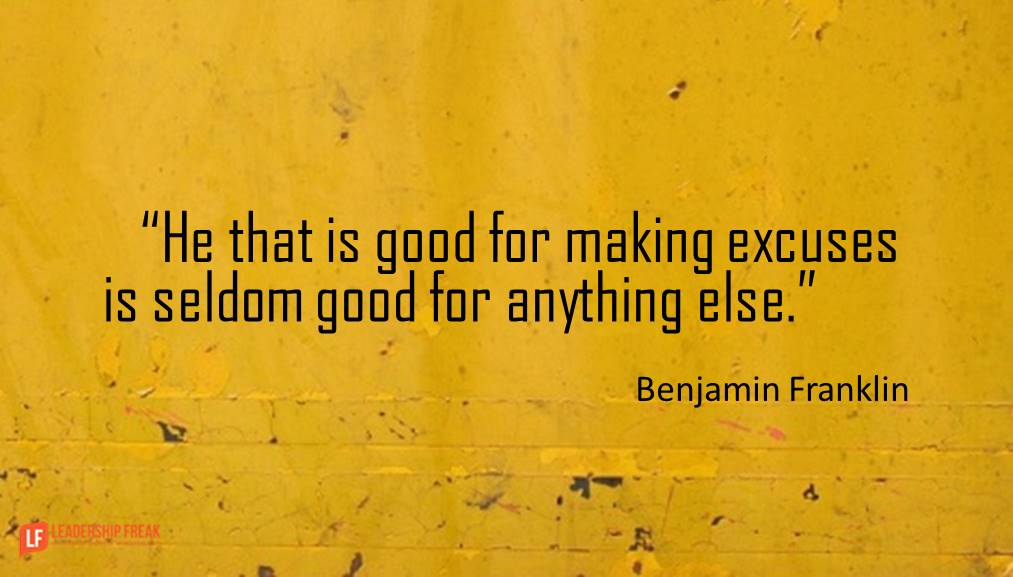
he-that-is-good-for-making-excuses-is-seldom-good-for-anything-else

Excuse-makers beguile naive leaders into expressing sympathy. 

Leaders who tolerate blame-throwing excuse-makers:

  1. Allow low performers to luxuriate and stagnate in mediocrity.
  2. Validate helplessness.
  3. Hold the wrong people accountable.
  4. De-energize high performers.
  5. Increase stress and frustration.
Excuse-makers promote, prolong, and propagate poor performance. Every sentence that begins with an excuse is an invitation to affirm weakness and validate poor performance.

Excuse-makers wallow in:

  1. Past failure. History repeats itself until you own it.
  2. Escalating mediocrity. All excuse-makers under-value imperfect action.
  3. Expanding blame.  Everyone who plays the blame game habitually relies on it, until someone confronts them.
Excuses are the reason careers get stuck, life is on hold, and relationships grow dissatisfying.

Excuse or explanation:

Eliminate excuse-making by knowing the difference between excuses and explanations.
Excuse: “I was waiting for you to tell me what to do.” This means the failure is your fault. Sentences that begin with, “I was waiting,” always end with a reason why lack of performance was some else’s responsibility.
Explanation: “I felt uncomfortable seeking direction.” Explanations express ownership and enable course correction.
Two questions that maximize an explanation.
  • What might I do to provide clarity next time?
  • What might you do to seek clarity next time?
Two question that crackdown on excuse-making.
  • What decisons did you make that led to this failure? (Sit quietly after asking this question.)
  • What will you do differently next time? (Seek behaviors not ideas.)
Never make excuses for excuse-makers.

Responsible failure:

An excuse is the reason someone didn’t try. Confront failures of neglect, apathy, and inaction. 
Curb excuse-making by honoring failures of energy, initiative, and effort. 
What is the difference between an excuse and an explanation?
How might leaders model the way when it comes to accountability?
CFE Banner

Comments

Popular posts from this blog

Chibuike okey ft Plan b - " I believe in you " (prod by Legacy)

  The brand new single from the stable of The Empire Of David's Musical Artist 

SEVEN STEPS TO SEE AND SOLVE BLINDSPOTS

Blindspots let you blame others for your shortcomings and feel superior while doing it. 5 common leadership blindspots: Evaluating yourself as a good listener, even though you can’t wait for others to stop talking. The discipline of listening is seldom achieved. It’s likely you’re more enamored with your voice than anyone else. Overvaluing your strengths while highlighting the weaknesses and faults of others. Overestimating the value you bring while undervaluing the potential of others. Believing you understand others, even though you ask few questions and make many judgments. Falling in love with yours solutions while criticizing the suggestions of others.   You think it’s problem-solving. Your team thinks you’re defending your viewpoint while nitpicking theirs. The worst blindness is seeing your blindspots and excusing them. 7 steps to see and solve blindspots: #1. Admit you have blindspots, even if you don’t see them. Just say it, “I have blindspots.” #2. Declare your intentions...

CEOS ON AVERAGE HAVE THE LOWEST EQ

“CEOs, on average, have the lowest EQ scores in the workplace.” However, CEOs with the highest EQ scores outperform their low EQ colleagues.   Emotional Intelligence 2.0 4 ways to elevate EQ for leaders: #1. Embrace the genius of ‘and’. Be tough   and   emotionally intelligent. Don’t choose between tough leadership and emotional intelligence.  Reflect on your feelings   and   the feelings of others.  Express empathy   and   high expectations. Believe in relationships   and   results. Give support   and   challenge. Enjoy power   and   give it away. Celebrate wins   and   set new goals. Make tough decisions   and   remain compassionate. Use ritual for stability   and   force yourself into new experiences. Apologize with humility  and   press forward with confidence. Express what you really want   and   stay open to others. #2. Believe negative feedback. One symptom...